Monday, September 24, 2012

SCOM 2012 - Monitoring Pack for SharePoint 2010

In the last week Microsoft has released the latest updated OpsMgr/SCOM 2012 management pack for monitoring SharePoint 2010.

Prior to this release, if you wanted to monitor and manage your SharePoint farms with SCOM 2012 using a Microsoft produced management pack, you had to either be a Microsoft employee, on a System Center Technology Adoption Program (TAP) or have participated in the SCOM 2012 Community Evaluation Program (CEP).

Thankfully I had participated in the SCOM 2012 CEP back last October and had access to a pre-release version of this management pack that basically added an additional Admin task to the SCOM 2012 console that supported the discovery and monitoring of your SharePoint 2010 farms.

As the pre-release version of the management pack I had wasn't officially supported by Microsoft, to say I was waiting patiently for this fully supported one to be released is an understatement!

This blog post will walk you through the steps required to get this MP up and running.

Prerequisites

The original Microsoft SharePoint 2010 Management Pack for OpsMgr/SCOM 2007 must first be downloaded and imported into SCOM 2012 before installing this updated management pack and you can download it from here (make sure to download the guide too):

http://www.microsoft.com/en-us/download/details.aspx?id=4419

Follow the instructions in the guide for the Microsoft SharePoint 2010 Management Pack for SCOM 2007 to install and import it into your environment. Make sure you have configured your Run As accounts as per the guide recommendations as they will be required later in this process.

Installation

Once you have the Microsoft SharePoint 2010 Management Pack for SCOM 2007 imported, you can now go about installing the updated management pack for SCOM 2012.

Download the System Center 2012 Monitoring Pack for SharePoint 2010 to a location on your SCOM 2012 server from here:

http://www.microsoft.com/en-us/download/details.aspx?id=34697

When the management pack installer has been downloaded, right-click on the .msi and choose the Install option


Accept the license agreement, then click Next


At the Select Installation Folder dialog box, make a note of the default installation location and notice that it will deploy to the  'Program Files (x86)' directory (this is important to know for a later step), then click Next


Click Close to finish the initial installation of the extracted the files


Browse to the location that the installer recommended and make sure that you can see the 'Microsoft.SharePoint.2010.SCOM2012' directory as shown below


Double click on the folder and you should see the new 'Microsoft.SharePoint.2010.SCOM2012.mp' file inside as below


Now, this is where things can start to go wrong with this management pack if you're not careful.

From the original location of 'C:\Program Files (x86)\System Center Management Packs\Microsoft.SharePoint.2010.SCOM2012', copy the 'Microsoft.SharePoint.2010.SCOM2012.mp' file to the following location as shown in the screenshot below. (Note: The copied location is not in the (x86) folder):

'C:\Program Files\System Center Management Packs'


Once you have copied the management pack file from the (x86) folder to the new location, in the SCOM 2012 console, browse to the Administration tab from the Wunderbar, expand the Administration view, right-click on Management Packs and then choose the Import Management Packs option to start the wizard.

In the Import Management Packs wizard, choose the Add from Disk option and then browse to the new location that you copied the 'Microsoft.SharePoint.2010.SCOM2012.mp' file to. If you've followed the instructions above, this location will be 'C:\Program Files\System Center Management Packs'. Double click on the coped management pack file and you will then see something similar to the screenshot below.

Note: If you haven't met the prerequisites and first installed the Microsoft SharePoint 2010 Management Pack for SCOM 2007, you will receive an error here stating that there is a dependency missing.


When you click on the Install button, you should then see confirmation that the new management pack has been imported successfully. Click the Close button to exit the dialog box.


Browse back to the Monitoring tab from the Wunderbar, expand the SharePoint 2010 Products view and then click on the Administration view. If all has gone according to plan, you should see your Microsoft SharePoint 2010 Farm Group in the central screen and on the right-hand side in the Tasks pane, you will now see the new 'Configure SharePoint Management Pack (SCOM 2012)' task as pointed out in the screen below


Click on the new task and you will be presented with the following dialog box - notice that the Working Directory value is set to: %ProgramFiles%\System Center Management Packs

It's this value that had the requirement for us to earlier copy the management pack file out of the (x86) directory and move it as without the file being copied, this task wouldn't run.


If you have correctly configured your Run As account for the Microsoft SharePoint 2010 Management Pack for SCOM 2007 as per the guide recommendations, then you should be able to just click on the Run button inside this task.

 You will then be presented with the following screen confirming that the discovery of your SharePoint 2010 Farm Group has been successful. Note: Make sure to wait a while for the discovery process to complete in your environment as it won't always show up in the console immediately.


That's all that you should need to do to get up and running with your SharePoint 2010 monitoring using SCOM 2012.

Sunday, September 23, 2012

The System Center 2012 Integration Guide

After a few weeks off on holiday/vacation, the batteries are fully recharged and I'm ready to hit the ground running - starting out with a lot of upcoming System Center 2012 projects to get stuck into. I'm also counting down the days now until our new  'Mastering System Center 2012 - Operations Manager' book hits the shelves towards the end of next month.

A consequence of being away on holidays for a few weeks means that when you come back, there's always an abundance of unread e-mails and Twitter feeds to catch up on. This blog post is about one such piece of information that caught my eye and deserved a mention.

Microsoft's Brian Wren recently published the System Center 2012 Integration Guide up on the TechNet Wiki and reading through it, I have to say it's an excellent resource and a recommended 'must-read' for anyone thinking of deploying System Center 2012 into their environment. (Thanks Brian!)

Taken directly from the guide's homepage:

"The System Center 2012 Integration Guide provides an overview of each System Center component in its role as a programmable platform to be leveraged for the Microsoft Private Cloud. It is intended to provide an abstraction layer that guides partners and customers on their decision process for methods to build automated solutions across System Center components."

There will be a separate section in the guide for each of the major System Center 2012 components and although the DPM integration guide hasn't been added yet, it has been labelled as 'coming soon' and we shouldn't have to wait too long hopefully!

To access the homepage of the guide, go to the following link:

System Center 2012 Integration Guide

If you want to browse directly to a particular System Center product's integration guide, then click on the links below:

System Center 2012 Integration Guide - Operations Manager
System Center 2012 Integration Guide - Orchestrator
System Center 2012 Integration Guide - Service Manager
System Center 2012 Integration Guide - Virtual Machine Manager

Each of the individual product integration guides have been broken down into sections such as a product overview,  their role in the microsoft private cloud, programmability, product specific Integration features/packs/points and then finally a System Center integration section.

Also, as this guide has been published on the TechNet Wiki, it means that System Center community members can add their own revisions and edit's to it (within reason and subject to moderation of course!) as they come across new and useful information - making it an overall excellent central resource when working with the integration of each of the System Center products.

Tuesday, August 28, 2012

SCOM 2012 - Visio Integration Add-In Not Loading

I've come across this issue randomly a couple of times over the past few months and have just had some time tonight to troubleshoot the problem and post it up here.

The issue relates to the Visio add-in for System Center 2012 - Operations Manager (SCOM/OpsMgr 2012) and the fact that in some cases, it simply doesn't load into Visio as it should do.

Typically, in my lab or test environments, if I am configuring theVisio and SharePoint integration of SCOM 2012 using the 'Visio 2010 and SharePoint 2010 Extensions for System Center 2012', I would download the file, unzip it and then run the Visio add-in installer on the computer that was running Visio 2010 Professional or Premium edition.

Generally, this would install without any issues and as soon as I open up Visio, the integration tab for Operations Manager is available. In some instances however, after the Visio add-in installer completed successfully, when I opened up Visio, the add-in wouldn't launch at all.

To troubleshoot, I opened up the Add-Ins tab from the File > Options menu inside Visio as below


When I clicked on the Go button to manage the COM Add-Ins, I was presented with a screen similar to the one below. I could also see from that screen that the Load Behavior was configured to 'Load at Startup', which means that I shouldn't have to do anything for the Add-In to start.


If I clicked on the check box for the add-in and then chose the OK button, the window would simply close with no warning and when I went back into it, I could see that the Load Behavior message had changed to the following:

Load Behavior: Not loaded. A runtime error occurred during the loading of the COM Add-in.


The solution to this problem in the end was actually quite simple. I found that the error tended to only occur when I was installing the add-in onto a server that had Visio installed on it as opposed to a client pc or laptop. In my lab/demo environments, I would normally just deploy Visio onto one of my SCOM management servers and enable the 'Desktop Experience' feature to allow for uploading graphics to SharePoint.

If I tried running the Visio add-in installer from a client pc or laptop, it always worked for me without issue so I went about comparing software prerequisites for the Visio add-in between my laptop and my servers. What I found was that on the server, I was missing the Visual Studio 2010 Tools for Office Runtime (VSTOR)  and this was listed as a requirement in the Visio and SharePoint extensions documentation.

If you have encountered this problem, then all you need to do is to go to the following URL and download the VSTOR package for your architecture (x86 or x64):

http://www.microsoft.com/en-gb/download/details.aspx?id=35594


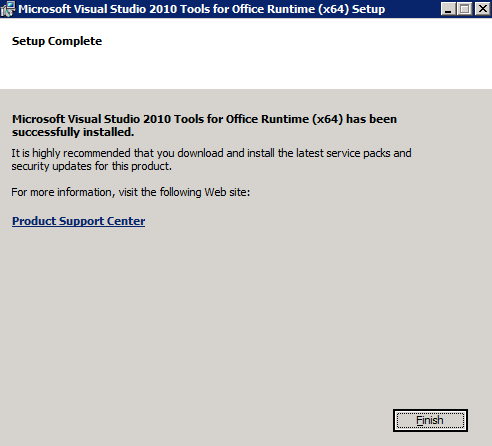
Once you have downloaded the tools, run the installer as an administrator and follow these screens to configure


When the tools have finished installing, open up Visio 2010 again and you should now be presented with an option to Install or Don't Install the Visio Add-In for System Center 2012 - Operations Manager. Click Install to continue


After you click Install, you will then be able to see the Operations Manager add-in tab from within you Visio window allowing you to configure integration to your SCOM 2012 management server.


Hopefully someone finds this quick solution helpful!

Wednesday, August 22, 2012

SCOM 2012 - The APM Consoles Part 2 - Application Advisor

In Part 1 of this series I walked through the Application Diagnostics console that comes as part of the System Center 2012 Operations Manager (SCOM/OpsMgr 2012) APM feature. This post will deal with the Application Advisor console that also comes bundled as part of APM.

Application Advisor Console Overview

The Application Advisor is a web-based console that comes bundled with over 30 pre-configured reports to help you to analyze event and performance issues over specified periods of time.It gives you transparency of the alerts that are causing you the most trouble, or generating the most noise and will give you a deep insight into a specific application’s overall health. In the words of the OpsMgr APM Product Team, Application Advisor is the tool that allows you to “follow the noise” in your APM environment.


Dependencies

As the primary function of the Application Advisor console is to deliver reports about APM, then it goes without saying that you will need to first have the SCOM Reporting role deployed for it to work. During the Application Advisor install a prerequiste check will kick off to see if you've already installed the SCOM Reporting role and if not, it will warn you that you need to have it installed first. Of course, this also means that you must have SQL Server Reporting Services (SSRS) installed too as it's a prerequisite of the SCOM Reporting role.

Launching

Similar to the Application Diagnostics console, if you want to launch the Application Advisor, there are several ways to do this. The easiest way is to open up a web browser and then input the URL of the Management Server that you've deployed the Web Console role to while adding /AppAdvisor to the end of it similar to:
 

Another way to launch the Application Advisor console is to logon to the server that you installed the Web Console to and browse to the built-in Start Menu shortcut at All Programs > Microsoft System Center 2012 > Operations Manager > Application Advisor as shown in the screenshot below


Update Feb 2013: I've made some changes to the required user account permissions below based on an inaccuracy/typo that Microsoft's Tim McFadden (Senior PFE) spotted while reading through this yesterday. Thanks Tim!

Security

Ensure that the user account you are logged in with has the relevant security permissions within SCOM to launch the Application Advisor console and be aware that these permissions are slightly different than what's required for the Application Diagnostics console. Your user account must be a member of the following roles:

  • Operations Manager Application Monitoring Operator Role

  • Operations Manager Report Operator Role 


  • Alternatively, if your user account is a member of the Operations Manager Administrator Role, then you will have access to Application Advisor regardless of membership of the above two groups.

    Using the Application Advisor Reports

    The following process will walk you through running an application report from within the Application Advisor console with some basic options being selected:

    Launch the Application Advisor console using one of the methods described above

    From the Navigation pane on the upper left-hand side, choose the drop-down arrow beside the All Application Groups option and select an application group to scope the report to (if you haven't configured any application groups, then you will only see the 'All' option here)


    Once you've chosen the application group, from the Select Report section you can choose the type of report that you want by simply expanding the Client Side Monitoring, Problem Utilization Analysis and Resource Utilization Analysis links or by clicking on any of the other seven reports. You can hover your mouse pointer over the name of a report to get a description box explaining exactly what the report gives you back.


    Once you've chosen your report, you will be presented with a number of  scoping parameters to define the the report contents. These parameters are as follows:

    • Start Date and End Date - allows you to pick the time range you want the report to contain data from
    • Status - this option relates to alert status and it defaults to New and Reviewed but there are also two other options for Deleted and By Design to choose from
    • Sources - by default, this option selects all of your monitored .NET applications but you can select a specific application to target the report to
    • Computers - allows you to focus on specific computers that are hosting your application
    • Problems - allows you to select All problems or just Critical problems
    Once you've made your selections, click the Apply button to save the configuration and generate your report.

    The screenshot below shows the output of a Problems Distribution Analysis report and in the top left-hand side, you can see that I've highlighted the Actions and Tools buttons as well as some icons just below these menus


    You can easily schedule the report that you’ve just generated by hovering your mouse pointer over the six icons just below the Actions and Tools menus and clicking on the Schedule Report icon to open the Schedule Management Wizard. This wizard allows you to make some changes to your report configuration parameters if required, and will then present you with a dialog box to input your e-mail address and format preferences as shown below


     Note: The e-mail option will only work here if it has been previously configured within SSRS.

    Exploring the Tools Menu

    You can access the Tools menu from any view or report inside Application Advisor and it contains six different tasks to help you administer your APM reporting environment. These tasks are detailed below:
     
    Task
    Description
    Options Provides the following event data options:
    • Lifetime period for events with a ‘Deleted’ status (hours)
    • Lifetime period for events with a ‘By Design’ status (hours)
    • You can also check and modify the Application Advisor web address here
    Schedule Wizard
    Enables the creation and modification of report schedules
    Favorites Wizard
    Allows you to save your favorite reports for future use without having to reconfigure them again.
    Remove Application Groups Wizard
    Helps you to delete unused application groups
    Remove Computers Wizard
    Deletes old computers
    Remove Applications Wizard
    Remove old application sources

    That concludes this short series of posts on the SCOM 2012 APM consoles. You can check out some other APM related posts of mine here:

    SCOM 2012 - Configuring Application Performance Monitoring (APM)

    SCOM 2012 - APM CSM vs. GSM and Web Application Monitoring....Confused?

    Hopefully you've found APM interesting and learnt something new about this cool addition to SCOM!


    Thursday, August 16, 2012

    Download the IPD Guide for SCOM 2012 (BETA)

    The new Infrastructure Planning and Design Guide (IPD) for System Center 2012 Operations Manager (SCOM/OpsMgr 2012) is now available for BETA review from the Microsoft Connect Site.


    The IPD guides are invaluable when designing a technology solution for your clients or own internal business and are the first port of call for me anytime I'm carrying out a new type of deployment for our customers.

    I've been waiting for this guide to be made available for a while - notably because I'm co-authoring a book on System Center 2012 Operations Manager and it certainly helps to have the knowledge contained in these guides when working on the architecture and installation chapters!

    The guide is over 40 pages long and deep dives into a design process which gets broken into different steps depending on your requirements and each of these steps are then further complemented with tasks that require actions to help you through the entire process.

    As the guide has just been released as a BETA last night, you will need to access it through the Microsoft Connect site and if you haven't registered here, will need to do so first.

    The benefits of using the Connect site though is that you can make comments and requests on the content of the BETA guide and if enough people make the same requests, then it's possible that the final release of the guide will have your changes included.

    Here's the link to register and download the IPD Guide for System Center 2012 - Operations Manager (BETA)

    https://connect.microsoft.com/site14

    Wednesday, July 25, 2012

    SCOM 2012 - Deploying Cumulative Update Rollup 2 (CU2) Hotfix

    Here, we go again with another round of Cumulative Updates to apply to your System Center 2012 deployments. Yesterday, Microsoft announced the release of Cumulative Update 2 (UR2) for the System Center 2012 suite and you can find a description of it here.

    Unlike Cumulative Update 1, this hotfix just provides resolution to five issues, three of which are on the Cross Platform/Unix/Linux side of the product.

    This post will walkthrough the steps required to deploy the Update Rollup 2 to your SCOM / OpsMgr 2012 deployment. This post is effectively an update of my previous post on deploying Update Rollup 1 (CU1) to SCOM / OpsMgr 2012.

    As before, the process to deploy the update is quite simple and this time there is no need to run any SQL queries against the SCOM databases as part of the update - as was the case with the SCOM 2007 R2 CU's. Some of the information below is taken directly from KB2706783 on the Microsoft Support website.


    To begin, here are some known issues to be aware of when deploying this update rollup:
    • Updates do not appear in the Add or Remove Programs item in Control Panel after you install Update Rollup 2.
    • The version number of the console does not change after you install Update Rollup 2. After Update Rollup 2 is installed, the version number of the console remains 7.0.8560.0.
    • After you install Update Rollup 2 on a web console, the following error occurs in Internet Explorer:
    Server Error in '/OperationsManager' Application

    To resolve this issue, close and then restart Internet Explorer.

      Installation Notes
      • Operations Manager Update Rollup 2 will at first be available only in English and cannot be applied to non-English versions of System Center 2012. Non-English versions of Update Rollup 2 will be available later in 2012.
      • You must run these updates as an administrator.
      • You have to close the console before you apply the console update to avoid having to restart the computer.
      • You must restart and clear the browser cache to start a new instance of Microsoft Silverlight.
      • This update rollup should not be installed immediately after you install the server. Otherwise, you could encounter an issue in which the Health Service state remains uninitialized.
      • If User Account Control is enabled, the .msp update files must be run from an elevated Command Prompt window.
      • System Administrator rights on the database instances for the Operational Database and Data warehouse are required in order to run updates on these databases.
      As described in KB911722, the web console fixes will work after you add the following line to the %windir%\Windows\Microsoft.NET\Framework64\v2.0.50727\CONFIG web.config file:

      <machineKey validationKey="AutoGenerate,IsolateApps" decryptionKey="AutoGenerate,IsolateApps" validation="3DES" decryption="3DES"/>Note This line should be added under <system.web>

      Note: As with all updates, it goes without saying that you should first make a full backup of your SCOM 2012 environment before proceeding with these steps.

      The supported installation order of CU2 is as follows:

      Server Infrastructure Deployment Order Overview:
      • Management server or server
      • Gateway servers
      • Reporting servers
      • Web console server role computer
      • Operations console role computers

      Note: If Connected MG/Tiering is enabled, the top tier should be patched first.


      Update Management Packs Overview:
      • Manually import CU2 management packs

      Agent Deployment Overview:
      • Apply the agent update to manually installed agents, or push installation from the Pending view in the Operations console.

      Note: This update rollup can be installed on agents either before or after server infrastructure.

      Installation

      Download CU2 to a location on your SCOM 2012 Management Server from the link below:

      Update Rollup 2 for System Center 2012 Operations Manager

      Right mouse click on the downloaded package and choose 'Run As Administrator' to begin the extraction of files


      Click Yes to accept the licence


      Choose a location to extract the files to (this can be a shared network folder if needs be), then click OK twice to finish the extraction


      You should now see the following files extracted to the chosen folder


      Server Infrastructure

      Now you need to apply the relevant .MSP package to your computers depending on the architecture (AMD64 or i386) and the role each one has in your SCOM environment (Server, Console, Web Console, Reporting, Gateway or Agent)

      Note: On servers that have User Account Control (UAC) enabled, be sure to run these updates from an elevated command prompt as you will most likely receive 'Access Denied' errors when running direct from the GUI.

      The server I'm installing this to is a single SCOM (OpsMgr) 2012 Management Server with the Console and Web Console roles deployed so in this instance, I have to install three packages - KB2731874-AMD64-Server, KB2731874-AMD64-Console, KB2731874-AMD64-WebConsole.

      In my environment, I also need to deploy the KB2731874-AMD64-Reporting package to my SQL Reporting Services (SSRS) server and the KB2731874-AMD64-Gateway to my SCOM (OpsMgr) 2012 Gateway server.

      To install a package, just right mouse click on it and then choose Apply from the menu as below


      You will see a window similar to the one below open up and run through some processes before automatically closing without any notification or reference to the process being completed.


      Once you have updated your server, browse to the SCOM 2012 installation folder - normally located at C:\Program Files\System Center Operations Manager 2012\Server. Once here, add a column view for 'File Version' and then sort the column by file version and you should see four files with a new version level of 7.0.8560.1027 as the screen below shows


      If you don't see the product version updated as above to your files, then your server hasn't updated properly and you will need to revisit the installation to see if you've missed something.

      Once you are happy that your first SCOM 2012 Management Server has been updated, then you can then move onto installing the new management packs that come with the CU2 hotfix.

      Note: You only need to import the updated management packs once. You will not have to carry out this process for every SCOM server role that you upgrade.

      To do this, simply open up the SCOM Console and click on the Administration button in the wunderbar from the bottom left hand side of the screen. From there, expand the Administration view, right mouse click on Management Packs and then select Import Management Packs from the resultant menu


      From the Import Management Packs window, click on the Add button, choose the Add From Disk option and then click on No when prompted to go online to download any dependencies


      You now need to browse to the location that you expanded the CU2 file into previously and you should see three management pack files (.MP). Select all three files and click on the Open button


      If you have previously upgraded to Cumulative Update 1 (UR1), then you will notice that the version of the Data Warehouse Library management pack is the same version number for CU2 and this will not be imported. If you haven't upgraded to CU1, then the import will upgrade all three new management packs at this point.


      Click on Yes from the security warning to confirm you are happy to continue


      Once the import is completed, you should see a successful status beside either two or three management packs (as mentioned above, the number of management packs imported here depends on whether or not you've previously upgraded to CU1) confirming you have imported them without issue


      When you have upgraded the first SCOM 2012 Management Server and imported the updated management packs into your environment, you then need to repeat the .MSP installation process on all of your other SCOM 2012 server roles as well

      Agent Infrastructure

      Although the agent installation upgrade can be carried out at any time, I prefer to wait until I have upgraded my SCOM 2012 server infrastructure first before working on the agents.

      To upgrade the agents using the SCOM 2012 Console, simply browse to the Administration tab again in the wunderbar, expand the Administration view, expand Device Management and then click on the Pending Management view to see all of the agents awaiting upgrade. Highlight the ones you want to upgrade, then click on the Approve link from the Tasks pane on the right hand side to update all of your push based agents


      For any agents that have been manually installed, then you will manually need to copy the .MSP file for the agent to each server and manually carry out each upgrade.

      Unix/Linux Infrastructure

      Once you've upgraded your Windows based servers and agents, all that's left to do now is to upgrade any Unix/Linux agents that you have in your environment. The following is taken directly from KB2706783:

      Installation instructions for Operations Manager UNIX and Linux monitoring packs and agents

      To install the updated monitoring packs and agents for UNIX and Linux operating systems, follow these steps:

      • Download and then install the updated management packs from the following Microsoft website:
      System Center Monitoring Pack for UNIX and Linux Operating Systems

      • Import the updated management pack for each version of Linux or UNIX that you are monitoring in your environment.
      • Upgrade each agent to the latest version by using either the Update-SCXAgent Windows PowerShell cmdlet or the UNIX/Linux Agent Upgrade Wizard in the Administration pane of the Operations Console.

      Note:The management pack bundle files for each UNIX and Linux operating system version contain the management pack and agent files. You may have to wait several minutes after you import the management pack bundle before the agent files are available for agent upgrades.

      That completes the deployment of SCOM 2012 Cumulative Update Rollup 2 (CU2) into your environment.

      Monday, July 23, 2012

      SCOM 2012 - The APM Consoles Part 1 - Application Diagnostics

      I don't know about you, but as a System Center consultant, I really appreciate when new features give us new consoles to work with as it keeps things different during deployments and when presenting.

      With System Center 2012 Operations Manager (SCOM / OpsMgr 2012), we have the new Application Performance Monitoring (APM) feature that allows us to deep-dive into the code of our .NET applications from a server and client-side perspective. APM comes with two new web consoles that are installed together during the deployment of the SCOM 2012 Web Console role.

      These are the Application Diagnostics and Application Advisor consoles and the aim of this short blog series is to give people a much better understanding of what they can do and how you can use them when managing your applications from an APM perspective.

      If you haven't yet configured APM in your environment or still aren't too sure about exactly what it is, then check out these previous posts to get you started before reading through this series:

      SCOM 2012 - Configuring Application Performance Monitoring (APM)

      SCOM 2012 - APM CSM vs. GSM and Web Application Monitoring....Confused?

      Application Diagnostics Console Overview

      Known as SE Viewer in AVIcode 5.7, the Application Diagnostics console is used to organize and link events across your monitored .NET applications to help you quickly ascertain the root cause of a problem. It allows you to analyze the individual performance and reliability events that are being raised within your .NET application along with the transaction chains related to those events to help you to understand how these types of issues are impacting your business applications.

      This console will be of definite interest to the members of the development team as it returns a whole raft of additional information that isn't available within the standard SCOM 2012 console as shown in the screenshot below.


      Launching

      If you want to launch the Application Diagnostics console, there are several ways to do this. The easiest way is to open up a web browser and then input the URL of the Management Server that you've deployed the Web Console role to while adding /AppDiagnostics to the end of it similar to:

      http://<WebConsoleServerName>/AppDiagnostics

      Another way to launch the Application Diagnostics console is to logon to the server that you installed the Web Console to and browse to the built-in Start Menu shortcut at All Programs > Microsoft System Center 2012 > Operations Manager > Application Diagostics as shown below

      Lastly and probably the most common way that you'll launch this console is by clicking on the scoped URL link in the Alert Description or Alert Context pane of an APM alert that is located in the Monitoring > Application Monitoring > .NET Monitoring > Active Alerts view of the Operations Manager console. The screenshot below shows an example of the scoped URL presented from within the Alert Description tab of one of these alerts.

      Security

      Regardless of the method used to open the Application Diagnostics console, you will still need to ensure that the user account you are logged in with has the relevant security permissions within SCOM to launch it. Your user account must be a member of the following roles:
      • Operations Manager Administrator Role
      • Operations Manager Application Monitoring Operator Role

      Inside the Console

      When you've launched the console, there are four navigation buttons that you can click on. Each one represents a different area that you can browse to that deliver the type of application diagnostics required to quickly find the root cause of a problem.

      These buttons are shown in the screen below


      Computers Button

       The Computers button gives you information on the computers that are hosting your .NET applications. From here, you can create and select new Application Groups that allow you to focus in on events orginating from the same applications.


      You also have the option of choosing between a Configuration view or a Resource Utilization view


      The Configuration view lists the computers that your monitored .NET applications are running on and delivers basic information about the number of CPU cores they're running and their monitored processes too.

      The Resource Utilization view also lists the computers that are running your .NET applications but returns additional information about resources such as % CPU Time, Memory, I/O and Application Load.

      If you click on the name of a computer from within either the Configuration or Resource Utilization views, you'll then be presented with a new window containing four tabs listed as follows:

      • Key Metrics - Average and peak values of the computers key metrics
      • Trend Reports - Reports on APM related performance counters over a given period
      • Monitored Processes - Details over a specified time, the process name, uptime and additional information such as PID, Framework version and application pool type
      • Monitored Applications - Overview of applications being monitored along with number of events, sessions and requests

      The screenshot below shows the four different tabs when clicking on a computer from within the Resource Utilization view


      Applications Button

      Clicking on the Applications button will give you a view very similar to the view you would see when clicking the Computers button as described above. However, this view displays information on the actual .NET applications as opposed to the computers that host them.

      Inside here, you'll see that you can still filter using scoped Application Groups if you wish however, clicking on an application from the central pane will present four slightly different tabs to work with. These tabs are:

      • Key Metrics - Display a performance graph with data from the application on its load, monitored requests and average request time.
      • Trend Reports - View trend reports on APM related performance counters over a given period
      • Computers - An overview of the computers being monitored along with the number of events, sessions and requests.
      • Topology - Overview of the basic topology of the application and gives a breakdown of where the events are happening based on chains across the server-side and client-side components.

      My personal favorite option here is the Topology tab and here you can segment alerts between the different .NET application components over a specified discovery period as shown below


      Clicking on either the server or client-side component within this Topology view, will open an Events view for your application with only the events and alerts that have been scoped for that specific application component source as seen in this screenshot


      Events Button

      Clicking on this button generally shows a large amount of alerts and events in the central pane, however, we have the option to filter event data based on criteria such as:

      • Status (New, Reviewed, Deleted and By Design)
      • Aspects  (Application Failure, Connectivity, Security and Performance)
      • Event ID
      • Description
      • User
      • Date (Any Date, From Recent Perfiod and Between Dates)
      • Location (Sources and Computers)
      • Client Data (IP and Session ID)

      In this view and from the central pane, we can see two different Sources for .NET application generated events (client-side and server-side) and these are easily identified in the Source column. When you click on an event here, the Source of the event will determine the different tab options available to you.


      The Aspect of your event will also determine the type of information returned back to you and if you want to see the well known (and often demonstrated) graphic of a client-side performance event, then click on a client-side event with an Aspect type of Performance as shown below


      Clicking on this type of event should then produce information similar to the following familiar screenshot


      Advisor Button

      Lastly, the only purpose of this button is to act as a shortcut to launch the Application Advisor console directly from inside the Application Diagnostics console. Part 2 in this series will cover Application Advisor in more detail.